Softpaq.exe File
This BIOS Flash Update SoftPaq contains utilities and data files that can be used to restore or upgrade the system BIOS on Hewlett-Packard business desktops. Several methods for changing the BIOS firmware stored on your computer are provided as described below.
ALERT: If upgrading from a v02.xx to this version, v03.xx, the user must first upgrade to version, v02.99, (SP73099). If not, upgrading to v03.xx will be rejected.Version, Softpaq #, Date, OS, Softpaq Exe, Release Notes. Setting of 'Check for newSoftPaq Catalog file' in configuration isn't saved correctly. Download the file by clicking Download or Obtain Software button and saving the file to a folder on your hard drive (make a note of the folder where the downloaded file is saved). Double-click the downloaded file and follow the on-screen instructions to extract the contents of the SoftPaq.
General Descriptions
Utilities and appropriate BIOS images are contained in each of the directories as follows:
DOS Flash - A DOS utility that can be used locally or with a Preboot eXecution Environment (PXE) management application to update or restore the System BIOS.
HPQFlash - A utility to locally update or restore the System BIOS on individual PCs in the Microsoft Windows operating system. No backup will be made of the current System BIOS.
This Softpaq can also be used with the following methods of updating the System BIOS:
System Software Manager (SSM) - Use this SoftPaq with System Software Manager (SSM) to update the System BIOS on target PCs over the local area network. Place this SoftPaq in your SSM Filestore folder and then update the database. SSM is a free utility provided by Hewlett-Packard Company. For information on SSM, see http://www.hp.com/go/ssm.
HP Client Manager Software (HPCMS) - Use this Softpaq with HP Client Manager Software (HPCMS) and Altiris Notification Server to remotely target, distribute, and update the System BIOS on networked PCs. Place this SoftPaq in your HPCMS Filestore folder and then update the database. HPCMS is a free management application provided by Altiris and Hewlett-Packard Company. For information on HPCMS, see http://www.hp.com/go/EasyDeploy.
NOTE: The Business Desktops BIOS Utilities SoftPaq is also available on the web. It contains additional utilities to support Hewlett-Packard Company products. The BIOS Utilities SoftPaq will be shown when searching for software support of products in the category BIOS and Firmware.
Windows BIOS Flashing
HPQFlash.exe is a utility which is designed to flash the System BIOS within a Microsoft Windows environment. To display the available options for this utility, enter [Path]HPQFlash -? at a command prompt or local search box. If the system has a BIOS Setup password enabled, then HPQFlash will prompt for the password to be entered before completing the flash process. For more information, view Readme.txt or HPQFlash.txt, both located in the HPQFlash folder. If you wish to update your BIOS using HPQFlash, click the link below. If prompted with a File Download dialog box, please select 'Open' or 'Run from current location'.
Launch HPQFlash
Using a USB Device to run HPQFlash
HPQFlash.exe can also be run from a USB storage device, including flash memory devices and external hard drives. To do this, insert the device and take note of the assigned drive letter. Copy HPQFlash.exe and ROM.CAB to the root of the drive indicated by the drive letter, or a folder on that drive. HPQFlash can then be executed from its location on the USB device. If the system has a BIOS Setup password enabled, then HPQFlash will prompt for the password to be entered before completing the flash process. For more information, view Readme.txt or HPQFlash.txt, both located in the HPQFlash folder.
View Contents of HPQFlash Folder
Startup Menu / F10 Setup BIOS Flashing
The HP Business Desktop systems provide a BIOS upgrade option through both the Startup Menu and the F10 Setup utility using the 'Flash System ROM' feature. Reboot the PC and press the Escape key to display the Startup Menu. Use the arrow keys to select Utilities, and then select the Flash System ROM option. Alternatively, reboot the PC and press F10 to access the BIOS Setup utility. In the File menu, select Flash System ROM. Either method requires that removable media be present (USB storage or data CD) that contains the BIOS binary image file in the root directory. The binary image file can be found in the DOS Flash folder and is named xxx_MMmm.bin where 'xxx' is the BIOS family, 'MM' is the major version number, and 'mm' is the minor version number. To create a CD for updating the BIOS, use a blank CD-R or CD-RW disk on a system with a CD-RW or DVD+RW drive, and write the binary to the disk using any CD-burning software (Windows 7 and Vista support burning data CDs without additional software). If a BIOS Setup password has been set, the password will be required before being able to access the 'Flash System ROM' menu. The user is notified when the process is completed. The new BIOS code will not take effect until the PC is restarted.
USB Device BIOS Flashing in DOS
DOS Flash (DOSFlash.exe, FlshUefi.cpu) is the DOS-compatible System BIOS flash utility that can be used from a DOS bootable storage device (where 'DOS' refers to any of a number of compatible operating systems such as FreeDOS, MS-DOS or DR-DOS). FlshUefi.cpu is the required driver for DOSFlash.exe. To flash the System BIOS from a bootable USB storage device, you will need to copy the contents of the DOS Flash folder to the USB device, boot the PC from the USB device, and execute the DOSFlash application. To see a more complete description of the DOS flash utilities, view DOSFlash.txt located in the DOS Flash folder. This folder also contains the required binary image of the BIOS. The binary image file is named xxx_MMmm.bin where 'xxx' is the BIOS family, 'MM' is the major version number, and 'mm' is the minor version number. This file can be copied to the root directory of any USB removable medium for use with the F10 setup 'Flash System ROM' option or BootBlock Emergency Recovery Mode.
View Contents of DOS Flash Folder
System Software Management (SSM) BIOS Flashing
Use this SoftPaq with System Software Manager (SSM) to update the System BIOS on target PCs on a network. Place this SoftPaq in your SSM Filestore folder and then update the database. SSM is a free utility provided by Hewlett-Packard Company. For information on SSM, see http://www.hp.com/go/ssm
HP Client Manager Software (HPCMS) BIOS Flashing
Use this Softpaq with HP Client Manager Software (HPCMS) and Altiris Notification Server to remotely target, distribute, and update the System BIOS on network PCs. Place this SoftPaq in your HPCMS Filestore folder and then update the database. HPCMS is a free managment application provided by Altiris and Hewlett-Packard Company. For more information, see http://www.hp.com/go/EasyDeploy
Network BIOS Flashing
The DOS Flash utility has been designed to support System BIOS flashing via a remote network boot using PXE. DOS Flash uses a small memory footprint that is compatible with the limited DOS memory available and the DOS extended environment that may exist while running Altiris eXpress. To see a more complete description of the network BIOS flashing utilities, view the DOSFlash.txt file located in the DOS Flash folder.
View Contents of DOS Flash Folder
BootBlock Emergency Recovery Mode
In the event of a failed BIOS update (for example if power is lost while updating), the System BIOS may become corrupted. BootBlock Emergency Recovery Mode detects this condition and will automatically search the hard drive and any USB media sources (hard drive, flash drive, etc) for a compatible binary image. The original factory image will have a suitable BIOS binary for automatic recovery without user intervention. Otherwise, the binary (.bin) file in the DOS Flash folder should be copied to the root (top level) of the desired storage device in a FAT or FAT32 partition, and the system powered on. Once the binary image is located, the BIOS will display a recovery screen and will start the recovery process. Do not power off the system until recovery is complete.
Aside from the root (top level) of a hard drive or USB device, there are two alternate paths that are searched for the recovery binary file. These can be used to configure for automatic recovery a system which has had the original hard drive image replaced or reinstalled with system software recovery media. The two valid paths for recovery other than root are 'Hewlett-PackardBIOSCurrent' and 'EFIHPBIOSCurrent'.
If the system has a BIOS Setup password, you may be required to use the Startup Menu / Utilities submenu to flash the BIOS manually after providing the password. Sometimes there are restrictions on which BIOS versions are allowed to be installed on a platform. If the BIOS that was on the system had restrictions, then only allowable BIOS versions may be used for recovery.
Copyright (c) 2011-2016 HP Development Company, L.P. All Rights Reserved.
Product names mentioned herein may be trademarks and/or registered trademarks of their respective companies.
Contents
- 1. What is SoftpaqDownloadManager.exe?
- 2. Is SoftpaqDownloadManager.exe safe, or is it a virus or malware?
- 3. Can I remove or delete SoftpaqDownloadManager.exe?
- 4. Common SoftpaqDownloadManager.exe error messages
- 5. How to fix SoftpaqDownloadManager.exe
- 6. February 2020 Update
- 7. Download or reinstall SoftpaqDownloadManager.exe
What is SoftpaqDownloadManager.exe?

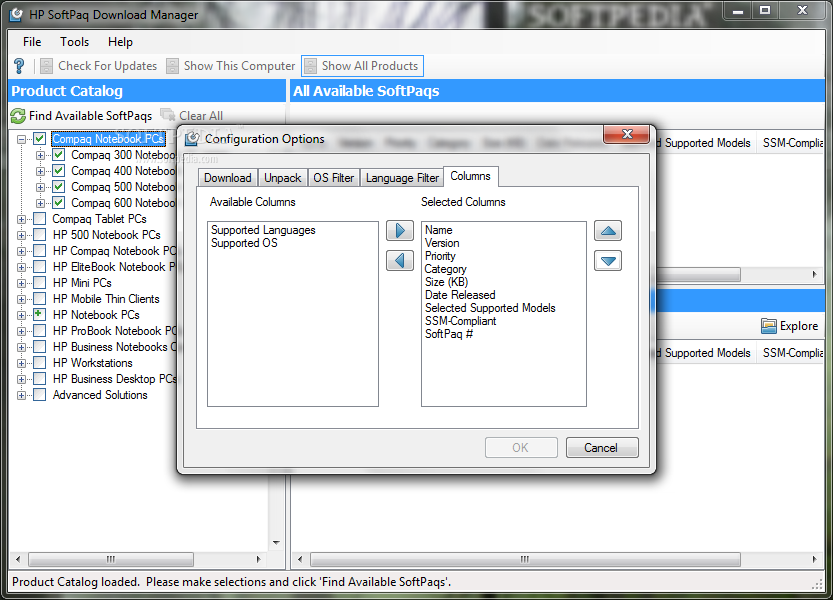
SoftpaqDownloadManager.exe is an executable file that is part of the HP SoftPaq Download Manager program developed by Hewlett-Packard. The software is usually about 14.16 MB in size.
The .exe extension of a file name displays an executable file. In some cases, executable files can damage your computer. Please read the following to decide for yourself whether the SoftpaqDownloadManager.exe file on your computer is a virus or trojan horse that you should delete, or whether it is a valid Windows operating system file or a reliable application.
Recommended: Identify SoftpaqDownloadManager.exe related errors
(optional offer for Reimage - Website EULA Privacy Policy Uninstall)
Is SoftpaqDownloadManager.exe safe, or is it a virus or malware?
The first thing that will help you determine if a particular file is a legitimate Windows process or a virus, is the location of the executable itself. For example, a process like SoftpaqDownloadManager.exe should run from C:Program FilesHewlett-PackardHP SoftPaq Download ManagerSoftPaqDownloadManager.exe and not elsewhere.
To confirm, open the Task Manager, go to View -> Select Columns and select 'Image Path Name' to add a location column to your Task Manager. If you find a suspicious directory here, it may be a good idea to investigate this process further.
Another tool that can sometimes help you detect bad processes is Microsoft's Process Explorer. Start the program (it does not require installation) and activate 'Check Legends' under Options. Now go to View -> Select Columns and add 'Verified Signer' as one of the columns.
If the 'Verified Signer' status of a process is listed as 'Unable to Verify', you should take a moment look at the process. Not all good Windows processes have a Verified Signature label, but neither do any of the bad ones.
The most important facts about SoftpaqDownloadManager.exe:
- Located in C:Program FilesHewlett-PackardHP SoftPaq Download Manager subfolder;
- Publisher: Hewlett-Packard
- Full Path: C:Program FilesHewlett-PackardHP SoftPaq Download ManagerSoftPaqDownloadManager.exe
- Help file:
- Publisher URL: www.Hewlett-Packard.com
- Known to be up to 14.16 MB in size on most Windows;
If you had any difficulties with this executable, you should determine if it's trustworthy before deleting SoftpaqDownloadManager.exe. To do this, find this process in Task Manager.
Find its location (it should be in C:Program FilesHewlett-PackardHP SoftPaq Download Manager) and compare the size etc with the above facts.
If you suspect that you may be infected with a virus, then you must attempt to fix it immediately. To delete the SoftpaqDownloadManager.exe virus, you should download and install a full security application like this. Note that not all tools can detect every type of malware, so you may need to try several options before you're successful.
In addition, the functionality of the virus may itself affect the deletion of SoftpaqDownloadManager.exe. In this case, you must enable Safe Mode with Networking - a secure environment that disables most processes and loads only the most required services and drivers. When there, you can run a security program and a complete system analysis.
Can I remove or delete SoftpaqDownloadManager.exe?
You should not delete a safe executable file without a valid reason, as this may affect the performance of any associated programs that use that file. Be sure to keep your software and programs up to date to avoid future problems caused by corrupted files. With regard to software functionality issues, check driver and software updates more often, so there is little or no risk of such problems occurring.
According to various sources online, 13% of people remove this file, so it may be harmless, but it is recommended that you check the trustworthiness of this executable yourself to determine if it is safe or a virus. The best diagnosis for these suspicious files is a complete system analysis with Reimage. If the file is classified as malicious, these applications will also delete SoftpaqDownloadManager.exe and get rid of the associated malware.
However, if it is not a virus and you need to delete SoftpaqDownloadManager.exe, then you can uninstall HP SoftPaq Download Manager from your computer using its uninstaller, which should be located at: MsiExec.exe /I{344A1AA2-AC8E-4741-BDB0-65B68FDA883C}. If you cannot find it's uninstaller, then you may need to uninstall HP SoftPaq Download Manager to completely delete SoftpaqDownloadManager.exe. You can use the Add/Remove Program function in the Windows Control Panel.
- 1. In the Start menu (for Windows 8, right-click the screen's bottom-left corner), click Control Panel, and then under Programs:
o Windows Vista/7/8.1/10: Click Uninstall a Program.
o Windows XP: Click Add or Remove Programs.
- 2. When you find the program HP SoftPaq Download Manager, click it, and then:
o Windows Vista/7/8.1/10: Click Uninstall.
o Windows XP: Click the Remove or Change/Remove tab (to the right of the program).
- 3. Follow the prompts to remove HP SoftPaq Download Manager.
Common SoftpaqDownloadManager.exe error messages
The most common SoftpaqDownloadManager.exe errors that can appear are:
• 'SoftpaqDownloadManager.exe Application Error.'
• 'SoftpaqDownloadManager.exe failed.'
• 'SoftpaqDownloadManager.exe has encountered a problem and needs to close. We are sorry for the inconvenience.'
• 'SoftpaqDownloadManager.exe is not a valid Win32 application.'
• 'SoftpaqDownloadManager.exe is not running.'
• 'SoftpaqDownloadManager.exe not found.'
• 'Cannot find SoftpaqDownloadManager.exe.'
• 'Error starting program: SoftpaqDownloadManager.exe.'
• 'Faulting Application Path: SoftpaqDownloadManager.exe.'
These .exe error messages can occur during the installation of a program, during the execution of it's associate software program, HP SoftPaq Download Manager, during the startup or shutdown of Windows, or even during the installation of the Windows operating system. Keeping a record of when and where your SoftpaqDownloadManager.exe error occurs is important information when it comes to troubleshooting.
How to fix SoftpaqDownloadManager.exe
A clean and tidy computer is one of the best ways to avoid problems with HP SoftPaq Download Manager. This means performing malware scans, cleaning your hard disk with cleanmgr and sfc /scannow, uninstalling programs you no longer need, monitoring any auto-start programs (with msconfig), and enabling automatic Windows updates. Don't forget to always make regular backups or at least define recovery points.
If you have a bigger problem, try to remember the last thing you did or the last thing you installed before the problem. Use the resmon command to identify the processes that are causing your problem. Even in case of serious problems, instead of reinstalling Windows, you should try to repair your installation or, in the case of Windows 8, by executing the command DISM.exe /Online /Cleanup-image /Restorehealth. This allows you to repair the operating system without data loss.

To help you analyze the SoftpaqDownloadManager.exe process on your computer, you may find the following programs useful: Security Task Manager displays all Windows tasks running, including built-in hidden processes such as keyboard and browser monitoring or auto-start entries. A single security risk rating indicates the probability that it is spyware, malware or a potential Trojan horse. This anti-virus detects and removes spyware, adware, Trojans, keyloggers, malware and trackers from your hard disk.
Updated February 2020:
We recommend you try using this new tool. It fixes a wide range of computer errors, as well as protecting against things like file loss, malware, hardware failures and optimizes your PC for maximum performance. It fixed our PC quicker than doing it manually:
- Step 1 : Download PC Repair & Optimizer Tool (Windows 10, 8, 7, XP, Vista – Microsoft Gold Certified).
- Step 2 : Click “Start Scan” to find Windows registry issues that could be causing PC problems.
- Step 3 : Click “Repair All” to fix all issues.
(optional offer for Reimage - Website EULA Privacy Policy Uninstall)
Download or reinstall SoftpaqDownloadManager.exe
It is not recommended to download replacement exe files from any download sites, as these may themselves contain viruses etc. If you need to download or reinstall SoftpaqDownloadManager.exe, then we recommend that you reinstall the main application associated with it HP SoftPaq Download Manager.
Operating system information
SoftpaqDownloadManager.exe errors can occur in any of the following Microsoft Windows operating systems:
- Windows 10
- Windows 8.1
- Windows 7
- Windows Vista
- Windows XP
- Windows ME
- Windows 2000
RECOMMENDED: Click here to troubleshoot Windows errors and optimize system performance